Roads That Lead Somewhere — Building the Plains Heartland
Published 2026-11-15
FLYGAME / DEVELOPMENT MAGAZINE / WORLD DESIGN · November 15, 2026 · Source-derived design essay
The problem with a continent full of nothing
A large RPG world can be impressive from a distance and still feel empty between the places that matter. The player walks through another field, another identical crossroads, another patch of trees—and learns that the land itself has little to say. FlyGame's next worldbuilding challenge is therefore not simply to create more tiles. It is to give players reasons to recognize, remember and return to places.
The existing Plains Heartland configuration already offers a starting point. It divides a regional 8×8 grammar into eight kinds of country: open border grasslands, pilgrim road, stonefields, an old battlefield, river meadows, outskirts, a crossroads village and farm country. Each describes more than a ground color. It carries a purpose.
Waypost is the place everything points toward
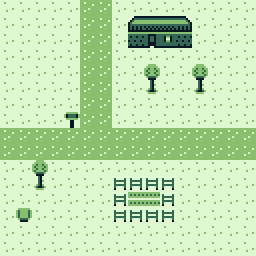
The grasslands provide distance. The river creates a crossing. Farm country suggests food and trade. The battlefield suggests history. Temple-road country suggests a larger story beyond the village. At their intersection sits Waypost, with a well, a market, services and a stable collection of authored characters.
The NPC catalogs give that settlement more than one function: an innkeeper talks about rest, a courier carries news, a scholar alludes to the Temple's deeper layers, and the Keeper introduces quests tied to an old stump, weather observations and region-specific progression. These authored dialogues are not proof that every interaction is currently reachable in the same ROM, but they demonstrate a worldbuilding direction: the geography and the people should explain one another.
Three roads with different identities
The current Plains regional grammar names three principal corridors. West Trade Road moves across border grasslands and river-meadow ford country toward the village. Temple River Loop descends from pilgrim-road country, follows water and approaches Waypost. Harbor Ferry Road connects the far side through battlefield and farm approaches to the market crossroads.
These distinctions matter on a Game Boy. A path that remains visually and functionally identical for every chunk cannot explain whether the player is approaching a settlement, ruins, river country or a remote trail. The art needs to vary, but the route still needs to connect. One cannot be sacrificed for the other.
Roads should be reserved before decorations
A November 15 Living World proposal argues for two layers: first, a deterministic graph of destinations and guaranteed route reservations; second, the existing chunk/edge-family composition system to supply visual variety inside those legal paths. In that proposal, a story-critical connection should not disappear because a local random score prefers an attractive but impassable arrangement.
This is a proposed engineering direction, not a newly integrated route solver. The written plan specifically calls for proving one complete travel loop before attempting mass population of a much larger world. It also calls out careful budgeting of directional road tiles, junction pieces and transition families, so variation does not exhaust the cartridge's art limits.
A player-facing test for every road
The quality question is simple: can a player leave a recognizable place, follow a legible path, pass at least one distinctive landmark or activity, and arrive somewhere that feels intentional? Can the reverse journey also be understood? Does a weather change, NPC warning or different terrain condition give that route a second meaning?
For FlyGame, answers to those questions will require more than a regional grammar or a successful procedural generator. They will require a current source-matched ROM in which ordinary travel and collision are observed across the complete route.
The next world is a collection of meaningful journeys
The strongest use of a large world is to give every region a character and every road a purpose. A farmer's advice makes sense because the fields exist. A courier's route means something because towns have borders and destinations. A pilgrim road feels different from a ferry road because the player can read the difference in the ground beneath their feet.
That is the opportunity in FlyGame's current authoring architecture: use generated scale to support authored identity, instead of asking sheer scale to become identity by itself.
Evidence notes: Active content/World/plains_region_grammar.json and content/GameplayConfig/npc_catalogs.ini / dialogue_catalogs.ini inspected November 15, 2026. Route-reservation and large-world recommendations come from docs/FG_LIVING_WORLD_ROADS_PLACES_PLAN_20261115.md, explicitly marked PROPOSED ROADMAP. Original village image from the August 19 project archive. No current-ROM route completion claimed.
Read next: Plains Heartland Atlas · People of Waypost · Explore the World · Development Journal